Wednesday, June 16, 2010

Mesa Verde Day 2

I visited Mesa Verde as a boy, on one of our wonderful family vacations. The place totally captured my imagination: ancient ruins that you had to climb ladders to see, a mysterious people that vanished without explanation. There were endless vista’s with endless possibilities because there were more sites out there that had not been discovered or excavated. You might find “something” at any moment.

This time around I found my imagination less captured. That was particularly true on the first day, when the experience was marred with American tourism, now seen through the eyes of an adult. Our Ranger for Balcony House knew very little, and spoke as though he knew it all. He was directly contradicted by other rangers we talked to or had as tour guides at different sites. Honestly, as nicely as I can put this, he was eye-rolling tedious.

DSCN0952

We were in mob sized groups and you couldn’t just look around and experience a place. You had to worry about the guy behind you bumping you off the edge in his mad dash to get the next photo. There were silly questions (and I’m usually patient) and people afraid of ladders. The Ranger would literally yell at anyone who was out of bounds. There was no peace. This unfortunate first tour rankled my nerves and began to make me regret stopping at Mesa (Disneyesque) Verde. I had read that more natural experiences were to be found through the Southwest if you were willing to detour off the paved tourist trails. (we are still hoping to do just that starting out tomorrow, when we head into Utah).

But fortunately that first negative experience was not the norm. Today was a pure delight. We had a 4:00 PM ticket for a tour of Long House and that dictated that we spend our day on the Wetherill mesa; described as the Quiet Side of Mesa Verde.

We are quiet people and really don’t like being treated like cattle (mooo!). I guess I got my fill of crowded clueless tourists working at Disneyland for 7 years. Today, I am happy to say, we were among smaller groups; they were less noisy, generally more thoughtful, and they were really fun to talk to. Many were doing the same things we were doing on this vacation and their questions were interesting and they gave us helpful touring tips. The sites were far less crowded and the were in fact, quieter. You could hear the wind in the canyons, song birds, the rustle of lizards and critters in the brush. It was wonderful.

Manco CO

Shiprock

After a lengthy drive with inspiring views (we could see Shiprock reportedly some 50 miles away, and had amazing views of Cortez) we pulled into the parking lot for the Wetherill Mesa area, named for the ranchers that were the first Anglos to discover the cliff dwelling ruins. Richard Wetherill , unfairly I believe, garnered a negative reputation with the Park Service as a pothunter: a derogatory term for people that scavenge ruins for potter and relics they can sell and make a lot of money off of. In truth, he became fascinated with the Anasazi culture and did much to further the discovery and excavation of sites all over the Southwest. He was a pioneer in early American archeology although he had no formal education in it. There was very little about Wetherill in park literature and signage but there was a shrine-like homage to Adolf Nordenskiold at the visitor center. Nordenskiold was arrested after doing archeology all around Mesa Verde because he was trying to ship a boat load of Anasazi relics to his home in Sweden. I won’t take the time here, but I could do a whole blog on political correctness and the National Park Service (and I’m highly supportive of the park service!).

Our first adventure today was to Step House: a cliff dwelling marked by stone steps leading into the village. Most Cliff dwellings were accessed by hand and toe footholds that would clime hundreds of feet up and down sheer rock walls. Step House is one of the few cliff dwelling sites that features a self-guided tour, so you can take your time. The walk down to it was stunningly beautiful in the cool noon air. The Ranger on duty would be our guide later in the day for Long House, and she was knowledgeable and easy to talk to. She was a highlight for us all today. Here are some photos of Step House:

DSCN0976 DSCN0980

DSCN0982

After a leisurely lunch out of our cooler, we took a tram ride (you have to take the tram on Wetherill Mesa) and saw several Mesa top sites, and two canyon overlook sites. We also saw a herd of feral horses, but I didn’t get any photos so you’ll have to wait for Cheryl’s to see the pony’s.

DSCN0990DSCN0993

We finished the day with a Ranger guided tour of Long House; the second largest cliff dwelling at Mesa Verde. It was a much more accessible site than Cliff Palace (the one you always see photos of), and you could more easily walk around the buildings, kivas and ruins. Our Ranger, Allison, focused her talk on plants of the area, giving us some insight we hadn’t heard on other tours. She was friendly and delightful. Here are some Long House Photos:

DSCN0995

DSCN0998

DSCN1000

DSCN1002

Today, I think some of my boyhood wonder was restored. I was able to imagine Anasazi life 700 years ago. I imagined daily life in the cliff dwellings. A common question asked of visitors is “Why did they build here.” You read the same question with speculated answers in books and park literature: “For protection”, “Natural water supply in the caves”, “Because their religion said they came from the ground.” Not once have I heard my favorite reason: They are spectacularly beautiful places to live.

Tuesday, June 15, 2010

Mesa Verde, day one


We tooled into Mesa Verde National Park (trudging through the requisite road construction) and checked out the visitor's center. The typical Mesa Verde visitor purchases tickets for tours of one or more of the three main attractions: Cliff Palace, Balcony House, and Long House. We purchased two tickets for today (Balcony House and Cliff Palace) and will do Long House tomorrow. Except that after the first tour, we almost just skipped the second two tours. The main drawback was a lack-luster tour guide (the nicest way I can put that) and the large crowd on the tour - both of which made us just want to just go hiking on our own. But the only way to see some of these places is to take the tour. 


One of the odd things to me is that the National Park service doesn't seem to enforce age limits for the strenuous tours. If you tell them that your two year old can make it up that 32 foot ladder without your help, you're good to go. If you cannot walk up the stairs to the second floor of a building and are wearing flip-flops, they will let you do the tour if you tell them you think you can. The Balcony House involved not only a very tall ladder as well as 18 inch passage way  you navigate on your hands and knees (ouch!).  I'm not afraid of heights, but even I was a little shaky at the top of that ladder. I climbed next to a woman in distinctly non-hiking footwear who literally shook all the way up that ladder. But we all made it (even the family with the two and three year olds), and the ruins at the top were worth the climb. 

After the Balcony house tour, we did the Mesa Top loop, which mostly included driving, with short turn-offs or hikes to view archeological sites of earlier puebloan settlements. My favorites were the cross-canyon views of mesa pueblos. Gorgeous.

On our trip across country, we've been reading In Search of the Old Ones by David Roberts. It's provided a wealth of information on the known history of the Puebloans as well as those who rediscovered and excavated their sites.We've also gotten invaluable information from Rick Shafer, author of a great blog on the Anasazi of Southwestern Utah (do not read this blog unless you are ready to pack up for your trip to this area).  I'm so glad we didn't come in 'cold' to tour this part of the country. There are still many questions about where the Puebloans came from, why they chose to live under the mesas, and where they disappeared to after 1300 AD. 

This picture was taken from the balcony staging area where we met for our tour. Our tour guide this time was a retired college professor with a master's degree in Southwest Archaeology. How perfect is that? For some reason the people on this tour were also more into it - very engaged in the tour. We knew going in that a good percentage of Cliff Palace had been reinforced in modern times, so we weren't surprised by the metal supports you see here and there. In spite of that, Cliff Palace is amazing. The ruins extend at least 100 feet back in to the cliff, and the more protected rooms still show original plastering and decoration. 

In this village of 100+ rooms, many rooms and just about every nook and cranny were devoted to storage. How much food would it take to feed your family and 75 of your closest friends for six months of bitter winter? I think it is clear that just as I would not have made it as a pioneer, I also would not have made it as a puebloan. I like large, walk in closets and have way more square footage to live in than I need. I can't plan grocery shopping that will last a whole week, so I know if I was in charge of stockpiling food for my family for a winter, we'd all have been dead without restaurants nearby. 


So in the end we enjoyed Mesa Verde today - it was a great introduction to the desert portion of our trip. But we are itching to get out of the crowds to the quiet. One of the best moments today was hiking out to an overlook and hearing the wind whistling through the juniper trees and being buzzed by swallows who nest in the cliffs. 

Monday, June 14, 2010

Durango to Silverton via Engine 482


I had mixed feelings about spending the money for the train trip we took today, but months ago I closed my eyes, clicked my mouse, and we were committed. It seemed like a good idea at the time . . . turns out it was an astoundingly good idea. We woke up bright and early for breakfast in our hotel (and yes, it was real food this time) and made it to the train by 8:30 for our 9:00 trip. It was a good thing, because Bob the tour guide did not appreciate the late-comers. When we reserved our trip, we had to decide which car we'd ride in, and we chose the Silver Vista, which boasted a glass roof and a tour guide. Bob the tour guide is a retired teacher whose wife waved to us from their campsite where they live for six months of the year while he "trains."
The website said to dress in layers, and they weren't kidding. We started with cool morning temps in the mid fifties, but the sun rapidly disappeared it got colder and colder. Everyone had to wear sunglasses due to the cinders which float back from the smokestack - a cinder in your eye can pretty much wreck your trip. Halfway into the trip you could feel the cinders coating your clothing and the surfaces around you. They did offer fully enclosed parlor cars, but we just could not resist the openness of that glass ceiling.

The train went through meadows, stands of aspen, between blasted rock walls, and along the Animas river as it climbed into the mountains. The steam engine billowed thick black smoke as it worked to haul the cars up the mountain. The highest elevation marker I saw was over 9,318 - that's a climb of almost 3,000 feet. Mark posted a video of part of the trip:


By the time we got to Silverton, it was sprinkling, so we decided to get into town quickly and sit down for some lunch. Our lunch at "The Pitts Two" was just in time. As soon as we started eating, it began to hail outside. The weather wasn't all bad - it just came in and out. We had purchased tickets for a return trip via bus, which saved us a few hours on our schedule. Turns out it saved us more than that - As soon as we got on the bus and the train pulled out for the return trip, it began to snow. We were very, very happy to be on that bus instead of on the freezing train!
 The trains pull right into town for loading and unloading.
 Silverton has a downtown with historic brick buildings and wooden clapboard buildings.
A large percentage were once bordellos or bars.Now they sell Fudge and tshirts.

Once back in Durango, we hit the road for Cortez and pulled away from the cool, cloudy mountain weather. The road to Cortez held promise for the next few days! Goodbye cowboys, hello indians . . . ahem . . Native Americans.

Sunday, June 13, 2010

Day Three: The Old West


If our trip could be divided into cowboys and indians, today and tomorrow are cowboy days. We drove over a mountain pass that was part San Juan National Forest. Unlike the National Parks we usually visit, this one did not have much in the way of 'scenic pullouts,' but they did have one, and it was a doozy. The picture above is one Amy took with her magic landscape feature.

Traveling over such rugged terrain on nicely paved roads, I found it hard to believe that anyone in a wagon made it. I can tell you right now that I'd have been buried along the trail (possibly alive, to shut up my whining). Durango, our stop for tonight, is in the Animas river valley and sits at 7800 feet. Wagon trains in the mid 1800's sometimes stopped here for a rest after their mountain passage while the men did temporary labor on the railroad,  The city of Durango was incorporated in 1880 and the hotel was built by a teenager (literally) in 1887. Our room is full of antiques, pressed wall paper, and custom wallpaper on the ceiling. When we moved into our little Speedway house, it had wallpaper on the ceiling . . . but somehow it wasn't as nice as this.
 After visiting the depot and museum (see Mark's entry), and getting a taste of what's in store of us tomorrow, we wandered the shops and bravely resisted some absolutely beautiful pottery and baskets. We did stop in for a cool Italian Soda (so appropriate Amy was wearing her Italia shirt) at a cafe. Then we ate dinner at a French Cafe - so much for Cowboys. Durango sure has changed.

Tomorrow: TRAIN! Good thing we're not excited about that, or anything. 


Alamosa to Durango

Today was a leisurely travel day. After traveling 1200 miles in two days, we were beat and took our time getting up. As usual, I was the first showered and dressed, and ate some breakfast at our Holiday Inn Express. Now a quick aside about "free" hotel breakfasts. They are generally pathetic and the Alamosa Holiday Inn Express lived up to those expectations. Why, oh why, can't they make Real Brewed Coffee. I guess to keep the general theme, that nothing is real: The eggs aren't what they're cracked up to be, the bread products were all frozen and look very unappetatizing, the "juice" comes a machine. Really, they could go for less and get more. Please America, stop trying to pass off instant coffee as "fresh" and "gourmet." We're supposed to get a free continental breakfast tomorrow in our expensive Durango hotel. We'll see how it compares.

Cheryl and Amy didn't bother with breakfast today, they each just had balance bar and called it a morning.The drive was wonderful today. Cheryl took the wheel since I'd done the lion's share of the driving the first two days. It was nice to sit back and snap photos out the window, mess with the music on the Zune, and navigate using my iPhone. The scenery was fantastic as you will soon see. We drove up along the head-waters of the Rio Grande and then crossed the continental divide and picked up the San Juan river for company. Along the way we saw . . .Well a pictures worth a thousand words so here are a few:


Just a little past the continental divide, on highway 160, we took a scenic view pull out and took some really fun shots. There was a waterfall visible from the turn out which we got closer to a little further down the road. Here are some photos:


We stopped for a picnic lunch in Pagosa Springs and watched the rafters taken on a small rapid. By the way, there are song birds all over the place and I just love listening to them. I can't always spot them but did see a Raspberry Finch singing his heart out today.

We pulled into Durango by 2:00 or so and got situated in our nostalgic hotel room. We spent the afternoon poking around in shops (reasonable prices for a tourist spot), and then poked around the Durango and Silverton railroad Depot. There is an excellent museum there and after touring it, I'm very, very excited about our excursion tomorrow. To whet your appetite, here's a video of the train pulling into the station. The sound of the steam train is worth the price of admission.

Enjoy,
Mark


Saturday, June 12, 2010

Long lost places

One of the things I love about long drives on country roads is that you get to see the long lost places. There are remnants of really old gas stations, businesses that never really made it, half built barns, and barns falling in on themselves. Growing up in the suburbs, old buildings are generally torn down to make room for new ones. But out here in the middle of nowhere, I suppose they just have so much land that they can afford to let old buildings bury themselves.
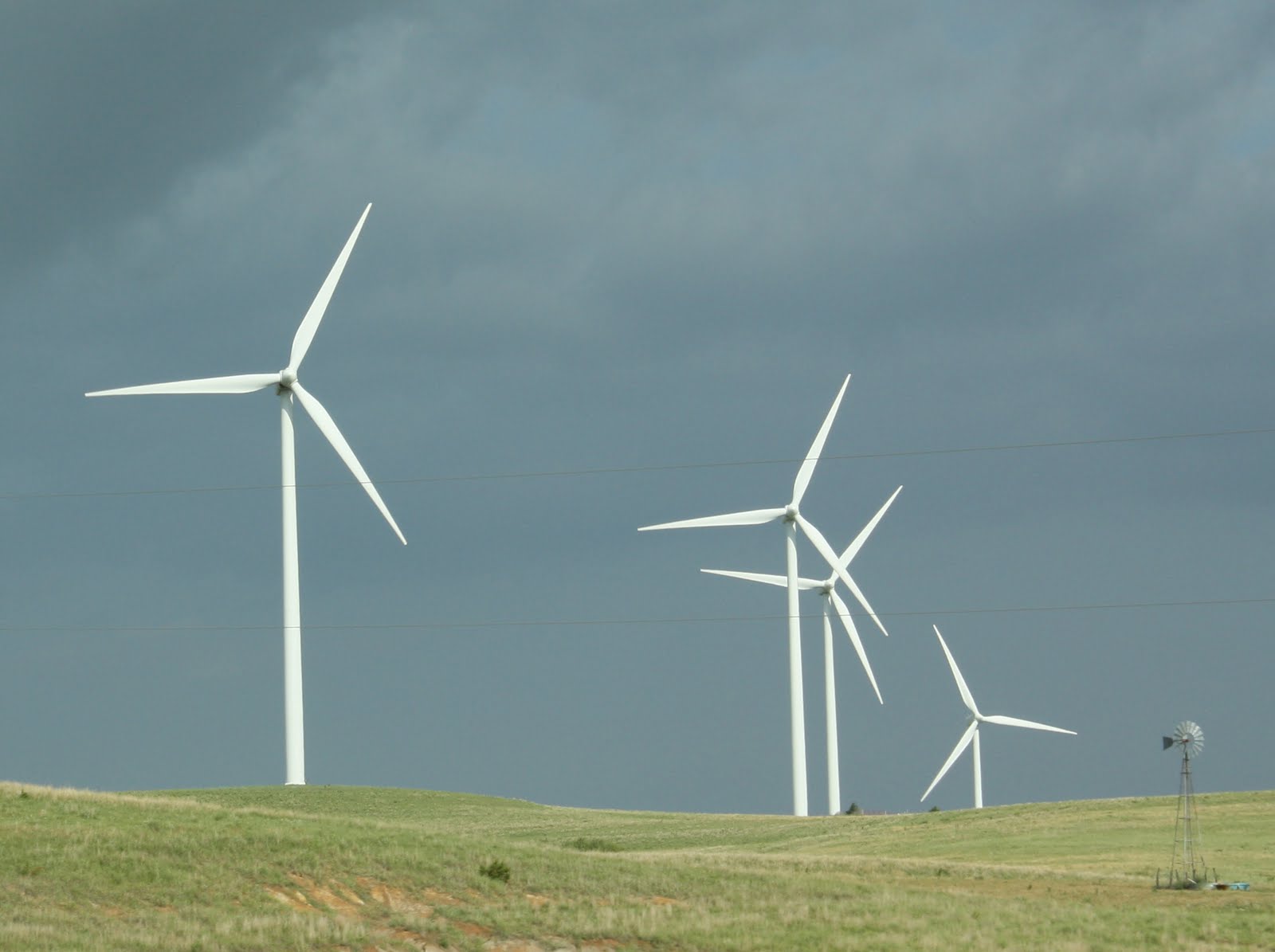
I really wish I'd gotten a picture of the line of rusting tanker cars left on an abandoned siding. There were dozens (we couldn't see the end of the line) - trees had even begun to grow around and through some of them. The contrast of seeing these long lost places in the same view with futuristic windmills is jarring.
Cows munch contentedly enough below these behemoths (of course, maybe they are content because they aren't in the "feed lots" we drove by). Old style windmills, like the one above in the bottom right corner, spin along smoothly, still doing the job they were created to do. The large windmills are so huge it is hard to show their size. We could clearly see the above windmill flock from at least 15 miles away. People who live near them even complain of headaches, possibly caused by the windmills' constant vibrations.


Somehow a fallen barn has beauty as it tumbles down, but what will these sci-fi giants add to the landscape as they age?

In the next days we'll see so many more lost (or at least old) places . . . and I will be able to take pictures of them standing still instead of from a moving car! We added more photos to the web album (just click on the mini slideshow at the top of the page). Let's hope for a good night's sleep tonight, and then it's on to Durango, Colorado tomorrow. The forecast is for rain, but we'd sure love some sun.

Day Two

Serendipity

(Mark writing) It was a day of contrasts and surprises.  We started out in the flat lands of Kansas in a mild thunderstorm and ended up in a high semi-arid valley between branches of the Rocky Mountains. In-between we saw wetlands, plains, a wild turkey, lots of birds, high desert, cinder cones, and drove through a high mountain pass of 9,000 feet in the fog.  It was a very fun drive, with constantly changing terrain.


Perhaps the highlight of the days drive was finding a Wetlands visitor center not too far off the interstate in Kansas.   Our Driving route was largely off the interstate today.  With a need for a restroom, we pulled into  a roadside spot which turned out to be the Cheyenne Bottoms Wetlands Preserve.  What a treat!  The staff were very friendly and the newly opened visitor’s center had a beautiful view of a wetlands teeming with birds.  I stepped outside on a walkway and was treated to a symphony of crickets, birds, and a prairie breeze. It was such a sweet moment.


Further down the road, we ate lunch in Dodge City, skirting the second largest meat packing plant in the country (it smelled terrible) and  a tourist trap trading on Dodge City’s wild west reputation.  We settled for Taco Bell and a quick “Get outta Dodge.”


Our Drive meandered through Southwestern Kansas and finally crossed into Colorado.  The terrain was continuously changing from flat prairie, to high plains and sage brush. Perhaps the best part of the drive for me was on State Highway 10; a little-traveled straight road through country gradually leading up to the Rockies. It was varied and the geography was fascinating. We were basically following along the Santa Fe trail for most of the day.